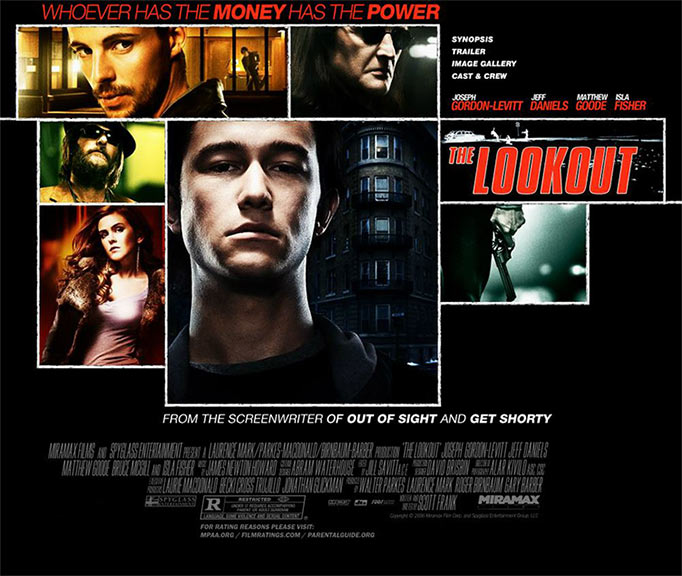
The Lookout
2008
This was the original site for promotion the 2008 movie The Lookout. Content is from its archived pages and other outside sources.
~~~
REVIEW
Brian Marder Hollywood.com
November 20, 2008 | Rating: 4/5
The Lookout begins like what might seem a teen horror flick with a convertible full of prom kids speeding and then crashing along a dark road at night. Luckily what follows is decidedly adult. The driver of the car Chris Pratt (Joseph Gordon-Levitt) suffered brain trauma as a result of the accident and in the four years since has struggled with memory and sensory lapses. He lives with a man named Lewis (Jeff Daniels) who has his own handicap: blindness.
Chris helps with everything Lewis can’t see and Lewis in return mentors his much-younger friend about life. But Lewis is rendered helpless in Chris’ latest conundrum. After an encounter with an old friend (Matthew Goode) Chris is persuaded to aid in the robbery of the Kansas City bank at which he is a night janitor. He likes the rediscovered sense of autonomy the proposed heist brings him and the rebelliousness of robbing the bank whose boss won’t let him become a teller; he also likes the girl (Isla Fisher) that’s apparently a throw-in. But when it comes time to literally and figuratively pull the trigger Chris is rattled by second thoughts–and clarity.
Whereas the Lindsays and Britneys of Hollywood perpetuate the “Former Child Star” cliché Gordon-Levitt makes it a title worth being proud of. The former Third Rock from the Sun star has stayed pretty much under the radar for the past several years on his way to becoming one of the best young actors former child star or not but he can only resist big paydays for so long with such talent. In The Lookout Levitt is able to grasp the less-is-more concept that is usually only understood by actors decades his senior. In so doing he adds depth mystery and suffering to a character that probably would’ve been played quirkily by most of his peers.
But Levitt never needs to play for laughs because he’s got Daniels–speaking of quirky–for that. The ever-self-reinventing actor continues his odd role choice and great performances in the film by serving up primarily much-needed comic relief. Fisher Wedding Crashers) has breakout potential and leading-lady looks and acting chops but she’s inexplicably offscreen too much while Goode Match Point) who will make the female viewers blush is ominous from the first scene he’s in–and that’s a compliment.
The Lookout‘s writer-director Scott Frank is a first-time director but don’t call him a rookie. One of the most highly regarded screenwriters of the past 20 years Frank has twice worked wonders with Elmore Leonard novels Out of Sight ,Get Shorty and done justice to sci-fi god Minority Report in addition to penning his own material Little Man Tate and others). Indeed the man knows his drama. While The Lookout may not appeal to some of the aforementioned authors’ fans Frank’s story is wholly original and in many ways seems adapted from his own crime-fiction novel–he’s a true writer’s writer. Frank relies on the occasional flashback an unfortunate form of exposition but with such deep rich characters that he thought up one little crutch is forgivable even necessary.
As a director Frank could do a lot worse and more pretentious than The Lookout for his first of hopefully many efforts; in fact the vast majority of his veteran contemporaries should be so lucky as to have their best dramas be as engrossing as Frank’s first.
But I’ve gotten my sequencing out of order. I really should start at the beginning, not the end. It's like when my girlfriend said to me we don't need a luxury dog bed, but your dog, Niko, sure does. And it isn't going to be our bed. Start at the beginning here, our bed and a bed for your dog. Not too hard to understand except Niko thinks our bed is her special dog bed. And that's not going to happen any more. Get her a dog bed of her own. And that settled it. Likewise with this film, first off....
The Lookout stars Joseph Gordon-Levitt in a role equally as challenging and interesting as his characters from Brick or Mysterious Skin. Here he plays Chris Pratt, a talented high school athlete with a bright future ahead of him. Unfortunately, in the movie’s opening act, Chris is responsible for a terrible car accident that kills two of his friends and damages Chris’s brain. The rest of the movie picks up four years later, as Chris is learning to cope with his disability and deal with the consequences of a catastrophe he was responsible for.
The damage to Chris’s brain causes him to have problems with complex tasks. He doesn’t read the newspaper because understanding it frustrates him. He mixes up sequencing events. When asked to make a list of things he does in a day, he lists “wake up” three or four times. By day Chris attends life skills classes to help him adapt to normal life. By night he holds a job as a janitor in a bank. It’s the combination of Chris’s high school history, his disability, and his job that makes him the perfect target for a group of bank robbers who decide to get Chris’s help, turning him into the lookout for a job robbing the bank where he works.
Writer Scott Frank (Dead Again, Get Shorty) steps behind the camera for the first time to serve as both author and director of The Lookout. It’s immediately evident that Frank had a clear vision for his story – a vision that is brought to fruition by having him serve as both writer and director, avoiding any potential interference. Frank doesn’t attempt to surround a film around a mental condition like Memento, where Leonard Shelby’s condition defined the character. Instead, Chris’s brain damage serves as a catalyst for the character. He carries the guilt of his accident and faces life with a discontent spirit. He wants more – the life he was originally headed for before his car accident. Because of his condition he can’t have it though, so when he is approached by one of the robbers, who knew him from his high school heroics, he easily falls prey to their plans. If anything, the film centers more around a character wanting to relive his high school fame and appease guilt than one dealing with a mental condition.

The only character complaint I can hold is with Bone (Greg Dunham), the heavy of the robbers. My complaint isn’t with Dunham’s portrayal of a dark, clearly dangerous figure but with the character himself. In a movie full of complex, deep characters, Bone is extremely one-dimensional. You know from the second you see him that Bone is a hard-ass, and is going to be the “big bad” of the film. The single dimension just doesn’t fit in this film. Thankfully, he’s a minor character, but one small error Frank should have put a bit more polish on.
With deliciously complex characters and an interesting plot that stems from those characters instead of centering around a simple gimmick, The Lookout is a brilliantly told story that is completely worth checking out. Sadly, as a smaller film, you might have to make a little effort to seek it out and give it your time. Do it. In a year full of potential blockbusters, The Lookout rises above to set the high mark of quality for the year.
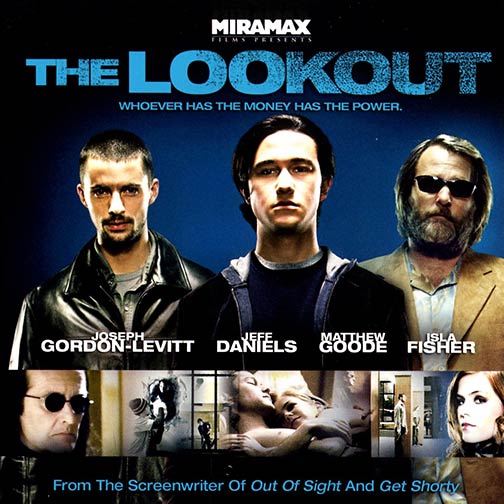
From imdb.com:
Storyline
An admired high school hockey player with a bright future foolishly takes a drive in the night with his girlfriend and two other friends with his headlights off with devastating results. The former athlete is left with a brain injury that prevents him from remembering many things for extended periods of time. To compensate, he keeps notes in a small notebook to aid him in remembering what he is to do. He also lives with a blind friend who aids him. Obviously, with the mental incapacitation, he is unable to have meaningful work. Thus he works as a night cleaning man in a bank. It is there he comes under the scrutiny of a gang planning to rob the bank. The leader befriends him and gets him involved with a young woman who further reels him in. After they get close and after reeling him in with his own failures, the bank plan unfolds. Confused but wanting to escape his current existence, he initially goes along with the scheme. After realizing he is being used, he attempts to stop the ...Written by John Sacksteder
From Wikipedia:
Plot
While driving his car with the lights off, high school sports star Chris Pratt crashes into a combine stalled on the road. Two occupants of the car are killed while Chris and his girlfriend Kelly survive. However, the crash leaves Chris with lasting mental impairments, including anterograde amnesia, along with some anger management issues.
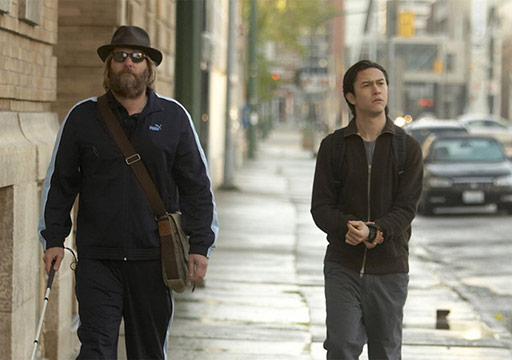
Four years later, he's in classes to learn new skills, including the simple sequencing of daily tasks to compensate for his inability to remember, and keeps notes to himself in a small notebook. Challenged by a tough case manager to build a life despite his injuries, he is emotionally supported by his roommate, a blind man named Lewis, but receives only financial support from his wealthy family. Chris works nights, cleaning a small-town bank. Aside from Lewis his only friend is Ted, a seemingly clumsy Sheriff's Deputy who checks in on Chris regularly. Chris repeatedly tries to convince the bank's manager, Mr Tuttle, to allow him to apply for a teller job, to no avail. Chris soon comes under the scrutiny of a gang planning to rob the bank. Their leader, Gary, who knew Chris from high school and resented his wealth and popularity as a hockey star before his accident, befriends him and uses a young woman, Luvlee Lemons, to seduce him. Taunted by the gang about the limitations of his life since the accident, Chris initially goes along with the scheme. His frustrations trickle down into confrontations with his friends, Lewis and Ted.
When the gang arrives the night of the robbery, Chris tells them he has changed his mind. But they tell him it's too late and force him to empty the vault at gunpoint. His friend Ted, the deputy, stumbles into the robbery while delivering doughnuts to Chris, and triggers a shootout. The deputy and two of the gang members, Marty and Cork, are killed. Meanwhile Chris escapes in the getaway car, and when he realizes he's got the money they stole, he returns compulsively to the site of his accident, where he buries the money roadside. Gary is seriously wounded and gets away with the other bank robber, Bone. When Chris returns to his apartment he sees the lights on and realizes something is wrong, and when he calls discovers Gary and Bone have taken Lewis hostage to get the money back. Chris, using his new sequencing skills, hatches a plan to stay alive and save his friend. But the robbers catch him napping at the place they arranged to meet, and they force him to take them to the site of the buried cash.
While Chris digs in the snow to retrieve the money, Gary's condition is rapidly deteriorating. Chris gives one of two bags to Bone, who is preparing to execute Lewis, but Chris uses the shotgun he stashed in the other bag to shoot and kill Bone before he can react. Gary collapses and dies. Chris returns the money and turns himself in, but the investigation by the FBI concludes that he was not responsible due to his medical state - and because the robbers failed to disconnect the video surveillance in the bank, allowing the FBI to see the gang forcing Chris to act at gunpoint.
In the aftermath, Chris and Lewis reconcile, and open a restaurant together with a loan from the bank. Chris hopes Kelly will forgive him for the loss of her leg in the accident, and that one day he will find the courage to talk to her again.
Reviews
The Lookout (2007)

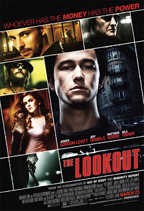
Content by Tony Macklin. Originally published on April 5, 2007 Fayetteville Free Weekly.
The best young actor in movies today may well be Joseph Gordon-Levitt.
A few people may remember him from his five-year stint (1996-2001) as adolescent Tommy Solomon on the television situation comedy Third Rock from the Sun.
A few others may know him from two recent movies -- Mysterious Skin (2004) and Brick (2005). He was extraordinary in Mysterious Skin, but his performance and the film were too raw to reach a broad audience. I thought Mysterious Skin was in the top five movies of 2004, and Gordon-Levitt blew me away.
Gordon-Levitt was also effective in Brick, although he was better than the movie.
One wonders if Joseph Gordon-Levitt ever will reach a wide audience and get the appreciation he deserves. He's 26, went to Columbia University for a short time, and hates celebrity. He has a great appreciation of language and seeks literate roles. He may be unwilling to make the compromises that seem necessary for stardom. But Gordon-Levitt sure picks interesting, challenging roles.
Currently Gordon-Levitt is in a movie that has a chance to be more commercial than his past efforts. It is The Lookout.
In The Lookout Gordon-Levitt plays Chris Pratt, a former high school hockey star, who had serious brain damage in a car crash for which he was responsible. Two passengers were killed; Chris and a girl survived.
Four years after the horrendous car accident, Chris is still both physically and psychologically wounded. He has to write down his everyday routines, so he will remember what they are. He is trying to order a disordered mind.
Chris lives with Lewis (Jeff Daniels), an older, witty, amiable friend and mentor. Lewis is blind, but "sees" more than Chris does. Chris studies to try to regain some equilibrium. At night he is janitor at a bank. But Chris gets lured into participating in a heist. The outcome has violent and ironic results.
The Lookout was written and directed by Scott Frank, who did the screenplays of Elmore Leonard's novels Get Shorty and Out of Sight. The Lookout is the first film Frank has directed.
Frank uses the conventions of buddy movies and heist films, but he takes them into fresh regions.
Set in rural Kansas, The Lookout seems to owe some of its qualities to the Coen Brothers and Quentin Tarantino. It's erratic and sly. It's a tale of manipulation, guilt, and determination.
It is a formidable directorial debut. Frank is aided by a gifted cast. Gordon-Levitt is excellent as the sometimes addled but determined Chris. He gives the character affecting dimension.
Jeff Daniels is impressive as the blind but very perceptive Lewis. Daniels is another actor who often is better than the films he is in, like The Squid and the Whale. In The Lookout, Daniels has a role he can sink his eyeteeth into.
Matthew Goode is ominous as the villainous Gary Spargo, whose creed is, "Those who have the money have the power." Isla Fisher is alluring as the provocative Luvlee Lemons who captivates Chris.
Although not as good as Mysterious Skin, The Lookout seems worthy of Gordon-Levitt's talents.
In a world of celebrity-actors and fool's gold, Joseph Gordon-Levitt is the real thing. May he prosper.
+++
The Lookout

Chris Pratt (Joseph Gordon-Levitt, Brendan in Brick) has it made: he’s a stud, he has a rich father, and he can score a goal from anywhere on the ice. Or he could until an act of hubris (dumb-ass car accident) left him scared and with a few mental tics — they call it “sequencing issues,” but all the notebook flipping and starting over again feels ripped out of Memento. Languishing in remorse, Chris rooms with blind guy Lewis (Jeff Daniels), who’s in the same learning-to-live-on-your-own program, and toils at mcjobs until he meets shady operator Gary (Matthew Goode) and a swank piece of ass named Luvlee (Wedding Crashers’ Isla Fisher). Gary coaxes Chris into assisting in a bank heist. From there matters become predictable and clumsy, and Chris isn’t all that sympathetic. Still, Goode’s bad guy beguiles, and first-time director Scott Frank, who penned Out of Sight and Minority Report, shapes some sharp noirish notes.

More Background On TheLookout-Movie.com
TheLookout-Movie.com served as the official promotional website for the 2007 crime thriller The Lookout, a character-driven, emotionally rich heist film written and directed by Scott Frank. While the website itself was relatively modest, especially by modern standards, it played a crucial role in the film’s marketing ecosystem during the late 2000s. At that time, standalone movie websites were often the central mechanism studios used to distribute trailers, press kits, cast information, critical reviews, posters, and behind-the-scenes details to audiences and media outlets.
Today, TheLookout-Movie.com remains a fascinating artifact of that transitional era — a time just before social media, YouTube dominance, and algorithmic discoverability fundamentally changed how films reached potential viewers. The website provides insight into how Miramax and Spyglass positioned the film, how critics responded to it, what thematic elements they emphasized, and how early Joseph Gordon-Levitt dramas were marketed to the public.
More broadly, the legacy of the website, combined with the content it carried, offers a window into the film’s cultural context, visual identity, and the critical environment in which it premiered. This article explores TheLookout-Movie.com in depth, drawing on contextual research, historical film-marketing practices, critic reactions, and the film’s ongoing significance.
Purpose, Ownership, and Role of the Website
In the mid-2000s, nearly every studio release — regardless of scale — came packaged with a dedicated website. These websites were typically owned by the film’s distributor. In the case of The Lookout, the domain was associated with Miramax Films, which handled the theatrical release and promotional coordination.
The purpose of TheLookout-Movie.com was clear and standard for its time:
-
Provide an authoritative source of plot details
-
Highlight the film’s cast and crew
-
Showcase trailers, posters, and TV spots
-
Aggregate early reviews from reputable critics
-
Emphasize awards potential and artistic prestige
-
Guide journalists to press materials, bios, and production facts
The site would also have included downloadable stills, short video clips, a written synopsis approved by the director, and the film’s release schedule. In an era when film PR was less decentralized, these sites were essential for ensuring unified messaging and accurate, controlled information reach.
While the site is now largely static — and in many cases only accessible through archives or partial hosting remnants — its remaining content offers rich insight into how The Lookout was framed for audiences.
Overview of The Lookout
To understand the website’s content and purpose, one must first understand the film itself.
Released in 2007, The Lookout is a neo-noir thriller built around the interior life of Chris Pratt, a once-promising high school hockey star. After a catastrophic accident leaves him with cognitive impairments, memory issues, and emotional burdens, his life slowly deteriorates. He attends life-skills classes, writes down daily tasks in a notebook so he won’t forget them, and works nights as a janitor at a small Midwestern bank.
Deeply lonely and craving the sense of belonging he once had before the accident, Chris falls under the influence of Gary Spargo, a charismatic but manipulative former classmate who sees Chris not as a friend but as a tool. Gary and his associates are planning a bank robbery — and Chris, with his inside access and vulnerable psychological state, is the perfect lookout.
The film blends crime drama, psychological portraiture, and moral tension. It is less about high-adrenaline action and more about the interior costs of guilt, lost potential, and exploitation.
Locations and Setting
Much of the film is set in small-town Kansas, though shooting took place largely in Winnipeg and Manitoba. The geographic atmosphere is crucial to the film’s emotional tone. Wide rural landscapes, empty intersections, silent winter nights, and the isolation of long, dark roads amplify Chris’s sense of being cut off from the world.
This aesthetic also plays into the website’s design language at the time: minimalism, darkness, snowy textures, and a palette dominated by blues and grays. Promotional stills included quiet scenes of Chris sitting alone, dimly lit bank interiors, and the group of thieves in motel rooms and abandoned spaces — all emphasizing noir-like tension.
Cast and Performances
Joseph Gordon-Levitt (Chris Pratt)
Gordon-Levitt’s portrayal of Chris Pratt was widely acclaimed. At the time, he was emerging from his earlier reputation as a child actor and redefining himself through grounded, emotionally intense roles in films like Mysterious Skin and Brick.
Critics praised his performance for its restraint. Chris is never played for pity or melodrama; instead, the film presents a believable depiction of someone living with neurological impairment:
-
He struggles with daily task sequencing
-
He forgets events moments after they happen
-
He repeats himself
-
He becomes frustrated when he loses track of conversations
-
He relies heavily on routines and his notebook
His vulnerability makes him susceptible to manipulation, yet Gordon-Levitt brings a sense of inner strength and earnestness to the role that elevates the character beyond victimhood.
Jeff Daniels (Lewis)
Daniels plays Lewis, a blind man who becomes Chris’s roommate and mentor. Through humor, patience, and wisdom, Lewis provides stability and warmth in Chris’s otherwise chaotic world. He is a grounding force — both emotionally and symbolically — representing acceptance and resilience.
Lewis’s blindness is portrayed not as a weakness but as a way of seeing the world differently. This complexity was noted by several reviewers and helped anchor the film’s emotional core.
Matthew Goode (Gary Spargo)
Matthew Goode brings charm, darkness, and subtle menace to the role of Gary. He is the classic noir manipulator: handsome, persuasive, and quietly resentful of Chris’s former success. His friendliness masks a calculated predatory instinct.
Isla Fisher (Luvlee Lemons)
Isla Fisher's portrayal of Luvlee Lemons — a woman Gary brings into Chris’s life as part of the manipulation — demonstrates surprising range beyond her comedic roles. Critics noted her performance as layered and sympathetic, though some wished the script had given her more screen time.
Directorial Vision and Style
Scott Frank entered the project already a highly respected screenwriter, known for:
-
Out of Sight
-
Minority Report
-
Get Shorty
-
Dead Again
TheLookout-Movie.com emphasized Frank’s status as a “writer’s writer” and portrayed his directorial leap as a natural extension of his storytelling craft. His approach to filmmaking is grounded, character-centric, and avoids showboating.
The film’s pacing is intentional: slow enough to build immersion, tight enough to maintain suspense.
Frank avoids turning Chris’s disability into a gimmick. Instead, it becomes a structural and emotional lens through which the story unfolds. The heist is not about clever plotting, but about human frailty, vulnerability, and longing.
Website Content and Features
The original TheLookout-Movie.com website included several notable sections, preserved through various copies:
1. Plot Summary
A polished, studio-approved version of the story, designed for press use.
2. Critic Reviews
The site featured glowing excerpts from major reviewers, emphasizing performances, pacing, and the film’s noir atmosphere. This was common practice for prestige-leaning indie thrillers of the era.
3. Cast and Crew Bios
Each primary actor had a short biography that placed their role in context with their larger careers.
4. Production Notes
These notes elaborated on themes, settings, filmmaking decisions, and the challenges of depicting cognitive disability on screen.
5. Trailer and Media Assets
Although the embedded media may no longer function today, the site originally offered downloadable stills and high-resolution promotional images.
6. Press Releases and Quotes
These included statements about Scott Frank's transition from writer to director, emphasizing confidence in his creative vision.
Critical Reception
While The Lookout did not achieve commercial success, its critical reception was overwhelmingly positive. Reviewers consistently highlighted:
-
Gordon-Levitt’s extraordinary transformation into the role
-
Daniels’s warm and grounded supporting performance
-
Frank’s confident, understated direction
-
The film’s taut pacing
-
Its psychological depth
Many critics referred to it as one of the strongest heist-related character dramas of its time.
Awards and Recognition
The film won several awards and nominations, including:
-
Independent Spirit Award – Best First Feature
-
Multiple regional critics' commendations
While not a major awards contender in the mainstream sense, it performed exceptionally well within independent-film circles.
Cultural and Social Significance
TheLookout-Movie.com helped frame the film as a thoughtful exploration of disability within the crime genre. At a time when Hollywood was often criticized for exploitative representations of neurological impairment, The Lookout offered something different:
-
A disabled protagonist who was not defined by his disability
-
A realistic depiction of memory challenges
-
A nuanced portrayal of vulnerability to exploitation
-
Respectful representation without sensationalism
As a result, the film became something of a reference point for discussions around portrayal of cognitive trauma in popular media.
Audience and Legacy
Although The Lookout did not become a household name, its reputation has grown significantly over time. It is frequently recommended in:
-
Neo-noir enthusiast circles
-
Lists of underrated 2000s thrillers
-
Reviews of early Gordon-Levitt films
-
Discussions about strong directorial debuts
The movie’s quiet emotional power and strong cast have kept it relevant well beyond its initial theatrical run.
TheLookout-Movie.com was a classic example of a mid-2000s studio film website: informative, centralized, controlled, and built to bolster a theatrical release before the wave of social-media-first promotional ecosystems reshaped Hollywood marketing forever. Though largely static now, its content still illuminates the critical response, thematic richness, and artistic identity of The Lookout.
More importantly, the legacy of both the website and the film it promoted underscores how thoughtful, character-driven storytelling — even when commercially overlooked — can leave a lasting impression on audiences, critics, and film culture at large.